The final day of CJP 2025 came to a close with a panel of aviation insurance company representatives who addressed several questions at the forefront of members’ concerns about insurability and skyrocketing premiums.
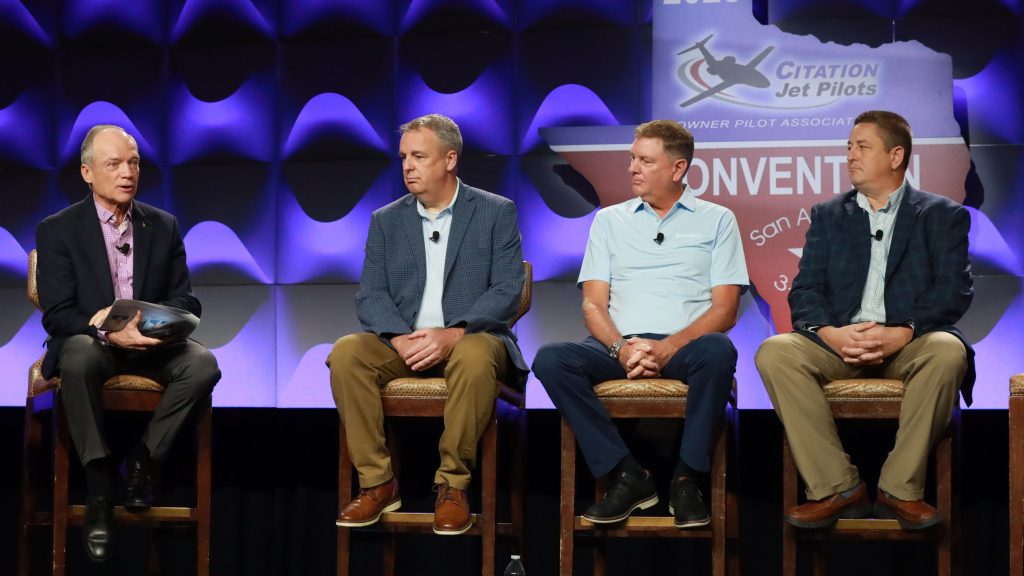
Photo by Stratton DV Imaging
Joshua Ray with Class A Aviation Insurance Services, Jeff Rhodes from 5×5 Insurance Services and Brian Van Horn with Old Republic Aerospace Insurance Group (along with Mike Chevrette, division president for aviation at Great American Insurance, who was unable to attend but shared a short video message for attendees) have backgrounds as either pilots or air traffic controllers. “We have underwriters who understand us,” said CJP Safety Chair Charlie Precourt.
The panelists cited the importance of CJP’s impressive, data-driven safety focus toward reducing accidents and the large insurance claims that follow. Rhodes emphasized his company’s data-driven approach to determining a pilot’s insurability.
“We are really taking a solid look at the really great work that the various owner/pilot associations are doing,” he added. “We’re looking at the data that’s being collected by the avionics in the airplane as a gauge of how an individual’s risk stacks up [against the] population, or how the population as a group fares compared to the standard risk.”
Ray gave the example of a 76-year-old pilot with an “impeccable” flying record who might be summarily rejected for coverage by legacy aviation insurance based on age alone. “We’re not drawing the line in the sand at any number,” he continued. “We’re looking at your flying ability, of what you’re doing in your habit patterns, and that’s how we’re judging you.
“I’ve always said that Charlie [Precourt] is in better shape than I am,” Ray quipped. “Why am I gonna tell him he can’t fly his airplane? Folks that don’t have the deep data sites that we do to write policies are going to have to make that arbitrary determination on whether or not they think you can fly, and we’re just not going to do it that way.”
Van Horn also noted the importance of thinking outside the box when it comes to working with aviation underwriters. “We look at our history and the judgment within each underwriter and within the company as a whole, to come up with solutions that are for the long term,” he added.
The panel also discussed the impact of liability and hull coverage on insurance rates. “It’s become a challenge as hull values are going up so high,” Van Horn said. “It’s not that we can’t accommodate it [but] we need to reduce the risk within that one aircraft. Because it’s going to be quite bell ringer if something happens.”
“You’re all very successful people, and in order to properly protect your assets you need to have proper liability limits,” Ray added. “Higher liability limits usually correlate to the quality of attorney you’re facing on the other side of the table in the event of a loss.”
While it may seem contradictory to the concept of an owner/pilot, Rhodes noted the safety and insurance benefits of being part of a managed fleet program.”
“Are you the very top of the food chain and making all those decisions?” he said. “With the right management structure, even if you’re the only person in that aviation department, provides a lot of value. And as long as you take it seriously and reporting to your own SOP rather than making decisions on the fly, I think it certainly improves your operational safety situation.”