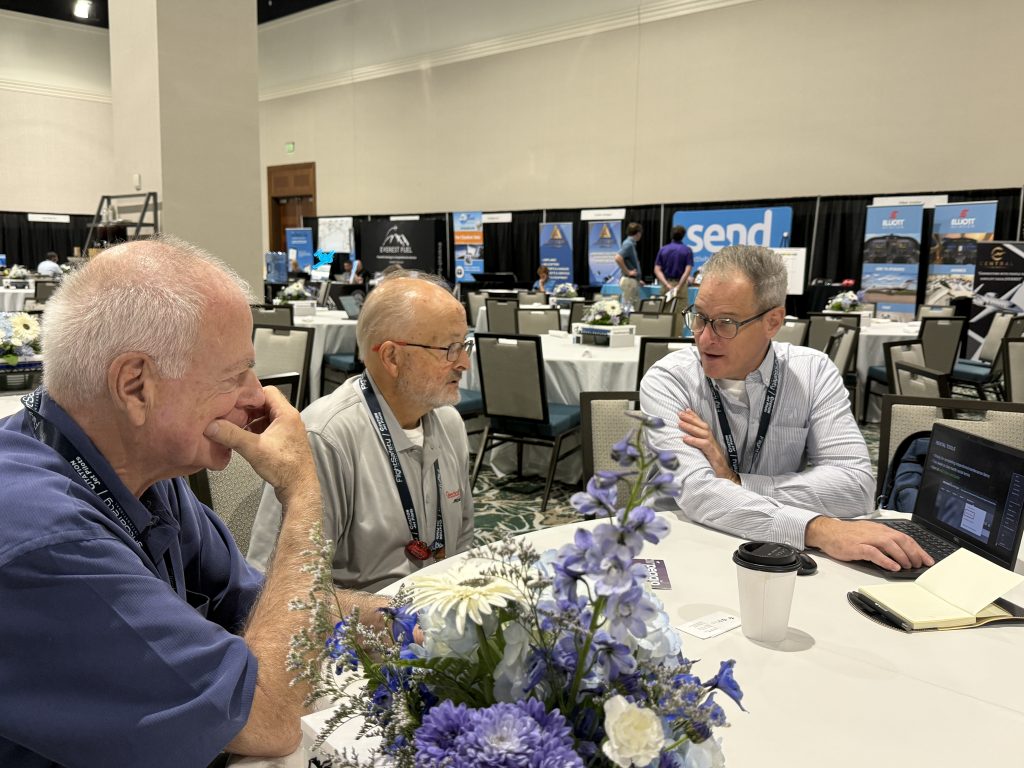
Two Beechcraft Premier owner/pilots attended their first CJP convention this year, where they had the opportunity to meet with members and discuss ways to improve support and maintenance for their jets.
Although Beechcraft ended production in the aftermath of the Great Recession, the composite-bodied Model 390 Premier I and IA remain highly competitive in the light jet segment. Roughly the size of a Citation CJ2, the Premier also uses the same Williams FJ44 turbofan, but with a nearly five-foot shorter wingspan contributing to higher cruising speeds.
Rick Weiner, a Texas-based Part 91 operator who’s flown serial number RB-37 for fifteen years. “I’m an avid [Premier] fan,” he said. “Obviously, I’m looking for all the support available to keep my plane flying.”
Scott Dickmeyer has taken a leading role in organizing a dedicated Beechcraft Premier owners and enthusiast community on Facebook, with close to 700 members. He served as program manager for Premier training at FlightSafety International before retiring last year.
In a sit-down session with Textron Aviation personnel, Dickmeyer said the bulk of those operating the approximately 262 Model 390s still flying feel increasingly orphaned. “I know almost everybody flying a Premier out there,” he said. “I’m trying to represent those that aren’t here and bring them into the CJP fold. [But] the overriding feeling is, ‘I don’t trust Textron to support the airplane anymore.’ How do we solve that?”
“If I can leave you with anything, it’s reassurance that we’re still committed to supporting all the Premier owners and operators,” replied Brad White, senior vice-president for global parts distribution and programs at Textron Aviation. “It’s a great legacy airplane.”
As with many Citation operators, key supply concerns in the Premier community include windshields, flap actuators and environmental systems. Weiner noted a problem specific to his airplane, a TRIM FAIL indication on climbout.
“No one’s been able to fix it, but I figured out how to avoid it,” he said. “Instead of doing an eight-degree climb, you do a five-degree climb.”
Other common service items on Premiers include wing and bulkhead corrosion checks and checking wear indicators on brake assemblies. White noted his team fulfills 93% of parts orders they receive the same day across the fleet, with 87% fulfillment for Premiers.

He suggested organizing a video conference for Premier owners to tell him directly the parts they need most. “A lot of our supply forecasting is recursive in nature,” White said. “If you don’t order a part, we don’t buy it. If we don’t stock it, you won’t order it. We are absolutely willing to make those investments, but we just need to make sure that we’re getting enough feedback on what is really [needed] out there.”
While there remains work to be done, Dickmeyer said he was encouraged by his first trip to the CJP convention, where he was also able to meet with Collins Aerospace (Premiers are equipped with Pro Line 21) and other OEMs. “It’s been extremely helpful to discuss the challenges and opportunities before us, and I’m grateful to CJP for including us in their community. Now I just need to get more of our people out here next year.”